

Why Appliance Efficiency Matters
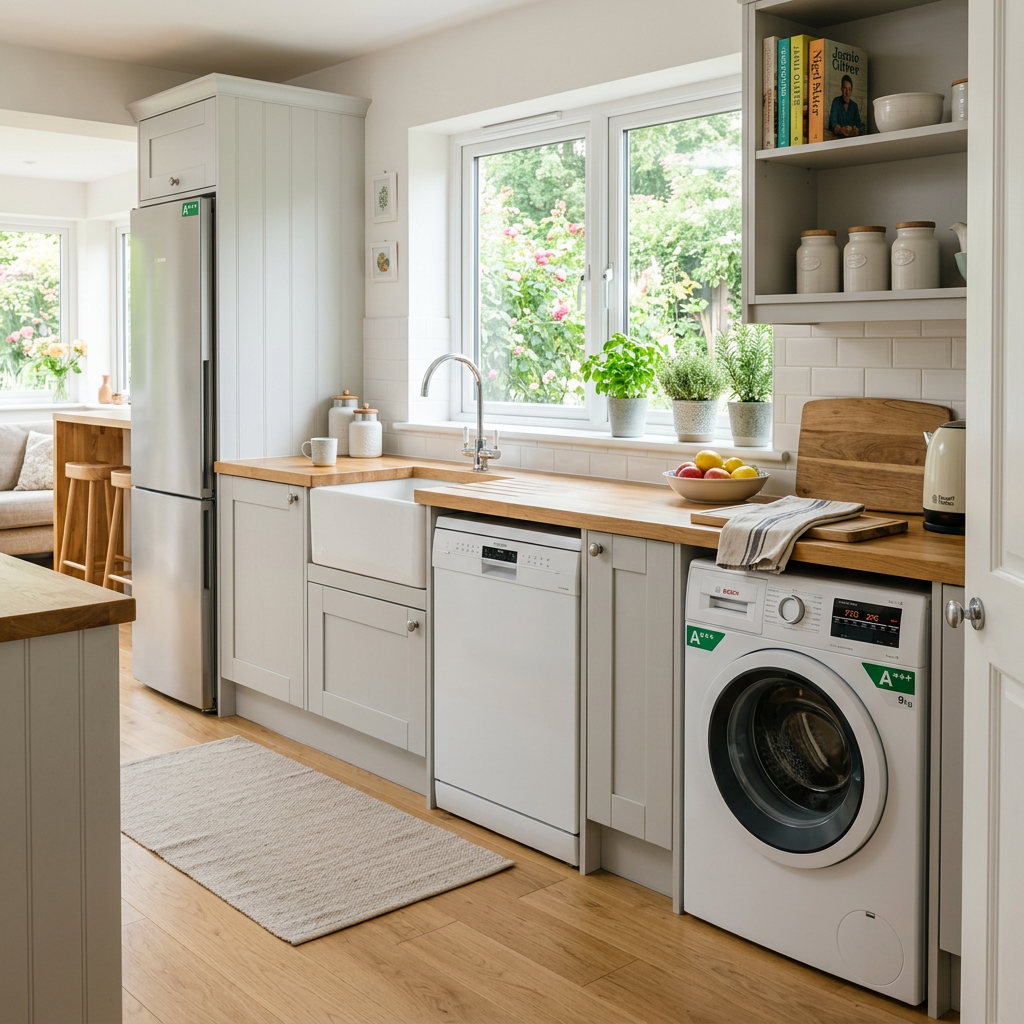
After heating, household appliances account for the largest share of most UK energy bills. Fridges, washing machines, dishwashers, tumble dryers, and televisions run constantly or are used daily — and the difference in running costs between an old, inefficient model and a modern A-rated appliance can be dramatic.
With energy prices remaining high by historical standards, the payback period on upgrading to efficient appliances has shortened considerably. Here’s where to focus your attention. If you want to take control of your energy bills, it only takes a few minutes.
Understanding Energy Ratings
Since March 2021, the UK (and EU) introduced a revised energy label system. The old A+++ ratings were retired and replaced with a rescaled A to G range — so an appliance rated A under the new system is genuinely exceptional, while many models that were previously A+++ now sit at D or E.
When shopping for new appliances, always check the new-scale rating. The energy label also shows estimated annual energy consumption in kWh, which you can multiply by your unit rate to calculate the yearly running cost. You can also energy saving tips to see what’s available.
Fridges and Fridge-Freezers
Your fridge is on 24 hours a day, 365 days a year — making it one of the biggest contributors to your electricity bill. An old fridge-freezer from the early 2000s might use 400–500 kWh per year, while a modern D-rated model uses around 200 kWh and an A-rated one under 100 kWh.
At current energy prices, switching from an old fridge-freezer to a modern efficient model could save £50–£90 per year in electricity alone. A good quality A or B-rated fridge-freezer typically costs £400–£700, meaning the running cost savings can pay for the appliance within five to eight years — and the appliance will likely last 15 years or more.
Washing Machines
Modern washing machines are dramatically more efficient than models from even ten years ago. Key improvements include better drum insulation, more precise water usage, and the widespread adoption of heat pump technology in premium models.
- Standard efficient models (B-rated): Use around 150–180 kWh per year based on typical usage — significantly less than older A+ machines.
- Heat pump washing machines: Use 30–40% less electricity than conventional models. More expensive upfront (£700–£1,200) but the running cost saving is real.
- Cold wash programmes: Using a 20°C or 30°C wash instead of 40°C cuts the energy used per cycle by around 60%. Modern detergents are formulated to work effectively at lower temperatures.
Dishwashers
A modern dishwasher, run on an eco programme, typically uses less water and energy than washing the same load by hand. The eco cycle runs at a lower temperature for longer, achieving the same cleaning performance with significantly less electricity and water.
Look for dishwashers with an A or B energy rating and always use the eco programme for everyday loads. Avoid half-load programmes — wait until the machine is full and run a full cycle instead.
Tumble Dryers
Conventional vented and condenser tumble dryers are among the least efficient appliances in the home, using 2–4 kWh per cycle. Heat pump tumble dryers use roughly half the electricity of conventional models and are now widely available at competitive prices.
If you use a tumble dryer regularly — say four times a week — switching to a heat pump model could save £80–£120 per year in electricity. A decent heat pump dryer starts at around £350, making the payback period three to four years.
Smart Appliances and Off-Peak Usage
Many modern appliances — particularly washing machines and dishwashers — include delay start functions that allow you to schedule them to run during cheaper off-peak electricity hours. If you’re on an Economy 7 or time-of-use tariff, combining efficient appliances with overnight scheduling maximises your savings.
The Bottom Line on Appliance Upgrades
The most cost-effective approach is to replace appliances as they reach the end of their natural life rather than scrapping perfectly functional items. But if an appliance is more than 10 years old and using significantly more energy than modern equivalents, the running cost savings can justify an earlier upgrade.
Whatever appliances you’re running, the biggest single lever remains your energy tariff. Even the most efficient appliances cost more than necessary on an expensive deal. Compare energy tariffs now to make sure you’re paying the lowest possible rate for every unit of electricity you use.


0 Comments